
Orchard Sprayer Guide: 7 Air Blast Sizes That Reach Every Leaf, from 300 to 2000 L
An orchard sprayer has one job a boom cannot do: push spray up and into the canopy of fruit trees and vines, so the inside leaves and top branches are covered as well as the outside. If you grow apples, citrus, mango, grapes or tea, this guide explains how air-blast units work, which tank size fits your orchard and tractor, and how to avoid the mistakes that waste chemicals.
Need a recommendation? Tell us your tractor power, soil and crop on WhatsApp +86 133 8469 2372 or and we will reply with a matching model.
How an Orchard Sprayer Works
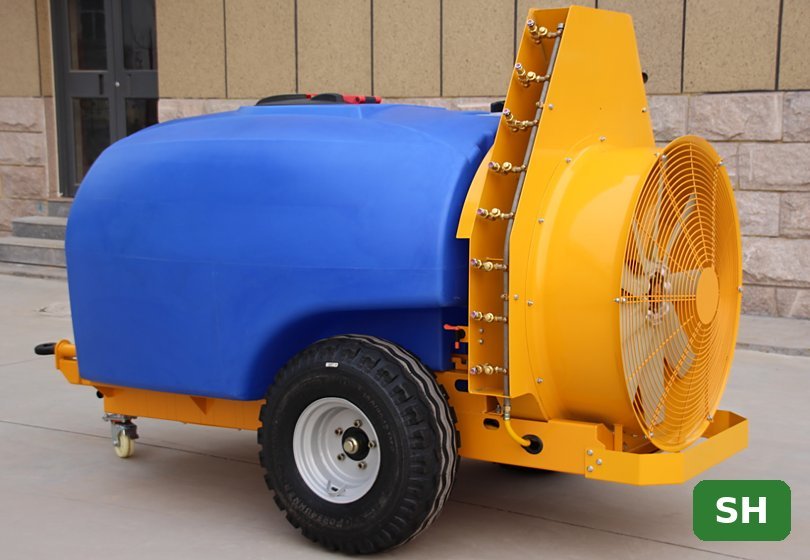
Our FS3SH orchard sprayer is driven by the tractor’s PTO. The PTO turns a pump that pressurises the spray liquid and a large axial fan at the rear. Nozzles are arranged in an arc around the fan outlet. The pump forces liquid through the nozzles to form fine droplets, and the fan’s air stream carries those droplets up and deep into the trees.
The air does more than transport the spray. It moves the leaves, so droplets reach both sides of each leaf and the inside of a dense canopy. Without air assistance, droplets from a boom fall short of the upper branches and only coat the outer layer. That is why this type is often called an air blast sprayer or a mist blower sprayer.
Before you choose a size, it helps to know the difference between the two main types we build. A boom unit sprays flat field crops from above; an air-blast unit sprays sideways and upwards into trees. Our article on boom sprayer vs orchard air-blast sprayer compares them in detail.
SH FS3SH Air Blast Sprayer Sizes
The FS3SH series comes in seven tank sizes. The capacities below are taken from our sprayers page; the right-hand column is a general guide, not a fixed rule.
| Model | Tank capacity (L) | General guide |
|---|---|---|
| FS3SH-300 | 300 | Small orchards and hilly plots |
| FS3SH-400 | 400 | Small orchards and hilly plots |
| FS3SH-500 | 500 | Family orchards and vineyards |
| FS3SH-800 | 800 | Medium orchards |
| FS3SH-1000 | 1000 | Medium to commercial orchards |
| FS3SH-1500 | 1500 | Commercial orchards |
| FS3SH-2000 | 2000 | Large commercial orchards |
Specifications are for reference and customisation is available. For row crops such as wheat, corn and cotton, choose a P3SH folding boom model instead.
How to Choose a Tractor Orchard Sprayer for Your Farm
Orchard area and refills. A bigger tank means fewer trips to the water point. As a guide from our sprayers page, 200–400 L suits small farms, 600–1000 L suits medium farms, and 1000–2000 L air-blast units suit commercial orchards. Work out how many hectares you must cover in one spraying window and how many refills you can manage in a day.
Tractor PTO power. The tractor must turn both the pump and the fan, so it needs enough PTO power for the size you choose, plus the weight of a full tank. Tell us your tractor model and HP and we will check the match.
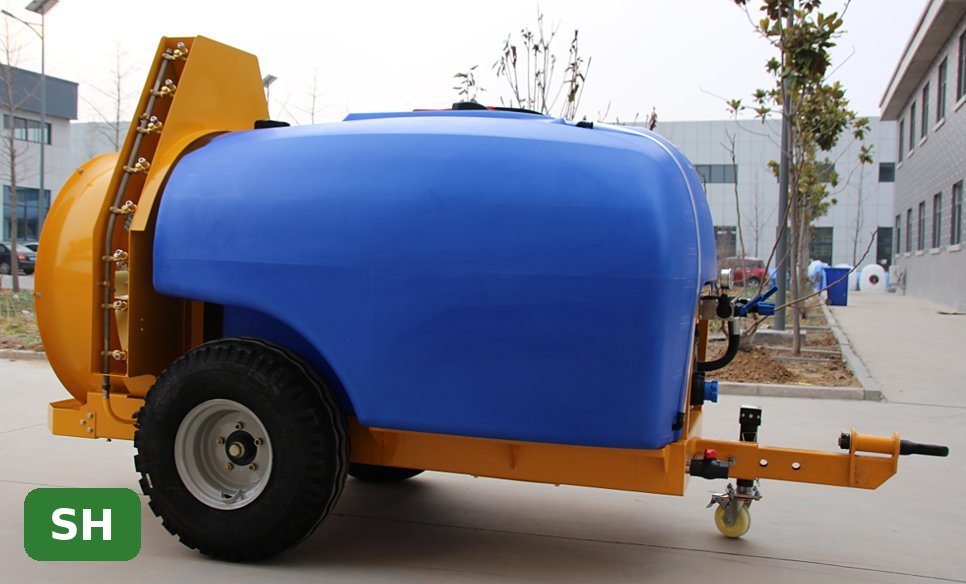
Row width and tree height. Measure the space between tree rows and the height of your trees. Narrow rows and low trellises suit compact units; wide rows of tall mango or citrus trees need strong air output.
Terrain. On hilly or terraced ground, a smaller tank keeps the outfit stable. Our selection assistant shows the models that match your tractor.
Orchard Sprayer Calibration and Safe Spraying Tips
- Check every nozzle. Fill the tank with clean water, run the pump and look for an even pattern from each nozzle. Measure each nozzle’s output for one minute and replace any that differ by more than about ten percent from the average.
- Aim the spray. Turn off the nozzles that would spray over the top of short trees or into the ground, and point the rest at the canopy.
- Set the rate. Measure forward speed, then adjust pressure or speed to reach the litres per hectare on the chemical label.
- Weather. Spray in calm conditions, early morning or evening, to reduce drift.
- Protection. Wear gloves, a mask and protective clothing when mixing and spraying.

Maintenance and Spare Parts
Flush the air blast sprayer after each day: rinse the tank, pump, lines and nozzles with clean water, and never empty rinse water near wells or streams. Clean the suction and line filters often, because a blocked filter starves the pump and makes the spray pattern uneven. Grease the PTO shaft and check the fan guard and bolts for looseness. Before freezing weather, drain the pump and lines completely. Nozzles, filters and pump parts can be ordered together with your sprayer, so keep a small stock on the farm.

Common Buying Mistakes
- Using a boom for trees. A boom unit cannot reach the canopy; trees and vines need a sprayer for fruit trees with air assistance.
- Too large a tank for the tractor. A full 2000 L tank is heavy. Match it to your tractor and your slopes.
- Ignoring row width. Check that the machine fits between your tree rows and can turn at the headland.
- No spare nozzles or filters. One blocked nozzle leaves a strip of trees unprotected.
- Skipping calibration. An uncalibrated machine wastes chemicals or under-doses the crop.
Why Buy Direct from the Factory
Shenghang makes every tractor orchard sprayer in our own factory in China and sells direct to dealers, importers and growers. We offer SH labelling and OEM options, export packing, and shipping by sea, rail or air; see export and shipping. You can add mowers for grass between the rows, trailers for harvest transport, and 4WD tractors to the same shipment. Safe, well-maintained application equipment is part of good practice, as the FAO explains in its work on sustainable agricultural mechanization.
Planning a new orchard spraying setup? Send your crop, orchard size and tractor HP on WhatsApp +86 133 8469 2372 or and we will suggest the right tank size.
Orchard Sprayer FAQ
What is the difference between an air blast sprayer and a mist blower sprayer?
Both use a fan to carry fine droplets into the crop. “Mist blower” is often used for small units and “air-blast” for tractor-driven orchard models, but the principle is the same.
What size sprayer for fruit trees do I need?
Small orchards usually choose 300–500 L, medium farms 800–1000 L, and commercial orchards 1500–2000 L. Count your hectares and daily refills before you decide.
Can a boom unit spray fruit trees?
Not well. Trees need air assistance to reach the canopy, so choose an air-blast model.
Can I order spare nozzles and pump parts?
Yes. Nozzles, filters and pump parts can be shipped with your machines.
Get a Quote
For a fast quotation on an orchard sprayer, send us the model (for example FS3SH-800), the quantity, your tractor HP, your crop and the destination port. Contact us on WhatsApp +86 133 8469 2372 or see all sizes on our sprayers page.
Comments
Please log in to join the discussion. Log in Register