
Potato Planter Guide: 1-Row vs 2-Row Planters for Tractors
Planting potatoes by hand is slow, back-breaking work, and uneven spacing costs yield at harvest. A tractor potato planter opens the furrow, drops each seed tuber at a set spacing, places fertilizer and covers the row in one pass. This guide compares 1-row and 2-row potato planters, explains how to match a planter to your tractor and field, and shares setup tips for an even stand.
How a Potato Planter Works
Seed potatoes are loaded into a hopper above the planting unit. A chain or cup elevator lifts the tubers one by one and drops them down a tube into the furrow opened by a share at the front. The land wheel drives the metering chain, so spacing stays the same whatever the tractor speed. Many models also carry a fertilizer box that places fertilizer beside the row, and a pair of covering discs at the rear that pull soil over the tubers and form a small ridge.
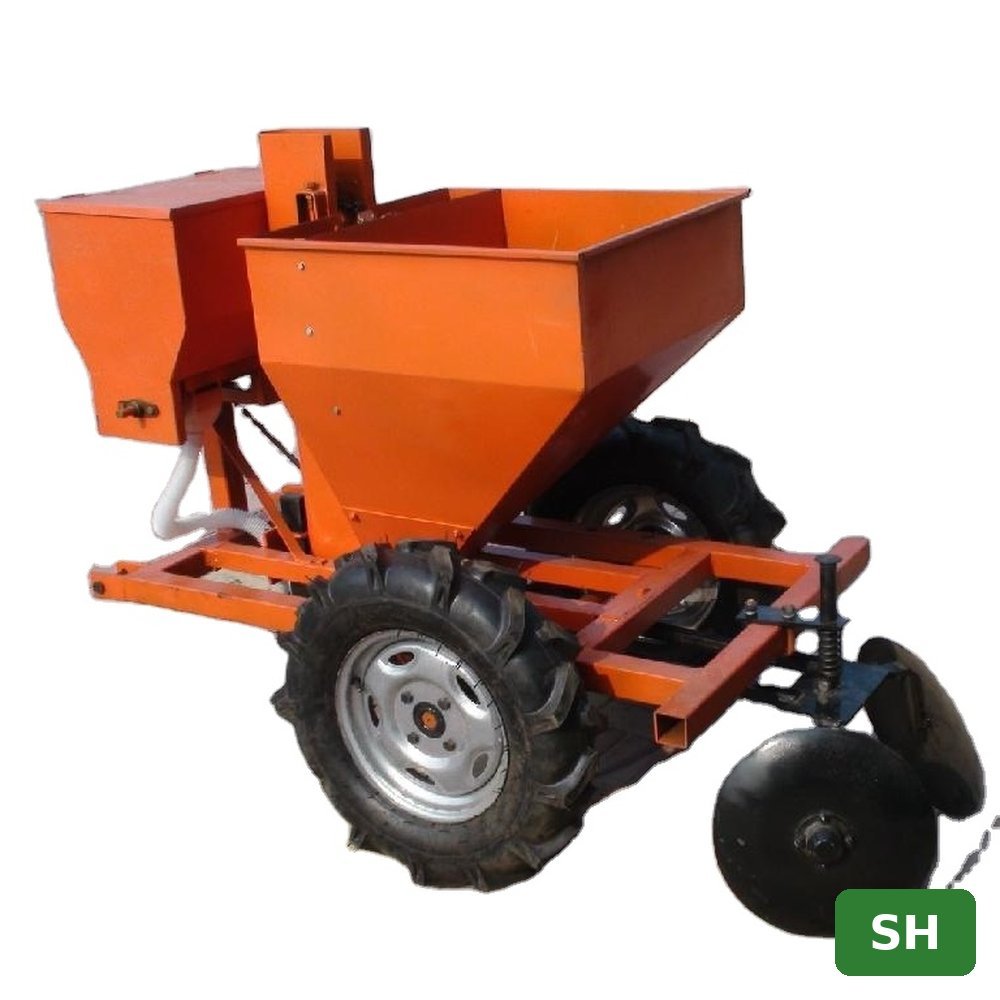
1-Row vs 2-Row Potato Planter
1-row planters are light, compact and need little power. They suit small farms, small tractors of about 15–30 HP, hilly or terraced land and fields with narrow headlands. They are also the easiest to transport and store.
2-row planters double the output per pass and are the better choice for commercial growers and contractors. They need a slightly larger tractor – up to about 50 HP – and a flat, well-prepared field. Some models carry seats so that an operator can watch the cups and correct missed or double drops.
Our 2SH tractor-mounted potato planters come in 1-row and 2-row versions for 15–50 HP tractors and cover about 0.1–0.6 hectares per hour, depending on model, row length and field conditions.

How to Choose the Right Potato Planter
- Area: under about 5 hectares a season, a 1-row machine is usually enough; above that, 2 rows save a lot of time.
- Tractor power: match the planter to the tractor you have, allowing extra power for hilly ground and full hoppers.
- Row spacing: choose a spacing that fits your ridger and harvester, so all machines run in the same wheel tracks.
- Seed size: uniform, medium-sized seed tubers give the most even spacing. Very large or cut seed may need different cups.
- Fertilizer: if you apply base fertilizer at planting, choose a model with a fertilizer box.

Field Preparation and Setup Tips
A planter can only work as well as the seedbed. Plough or deep-till the field, then break clods with a disc harrow or rotary tiller so the furrow opener runs at an even depth. Before starting:
- Set planting depth – commonly 8–12 cm to the top of the tuber, deeper in light, dry soil.
- Set in-row spacing with the drive sprockets, then check it on the first 20 metres.
- Calibrate fertilizer rate by turning the land wheel a set number of times and weighing the output.
- Keep the hopper at least a quarter full so the elevator fills every cup.
- Drive at a steady, moderate speed – too fast causes skips and doubles.
From Planting to Harvest
After emergence, earth up the rows with a disc ridger to cover the developing tubers, control weeds and improve drainage. At the end of the season, a 4U potato harvester lifts the crop and lays it on the surface for picking: the 4U-1 works 0.6 m wide behind 25–45 HP tractors and the 4U-2 works 0.9 m wide behind 50–70 HP tractors. See our harvesters page for details. For very small plots, we also offer a potato planter for walking tractors.
Planting on time with even spacing is one of the simplest ways to raise potato yields. The FAO’s work on sustainable agricultural mechanization explains how the right equipment helps farmers save labour and work on time.
Related guide: Potato ridger guide: matching disc ridgers to your row spacing
Potato Planter FAQ
What tractor do I need for a 2-row potato planter?
Usually 30–50 HP, depending on soil, slope and whether the fertilizer box is used.
Can I plant cut seed potatoes?
Yes, but cut pieces should be cured first and graded to a similar size for even spacing.
How many hectares can I plant per day?
At 0.1–0.6 hectares per hour, a typical working day covers roughly 1–5 hectares depending on model and field layout.
Is a potato seeder the same as a potato planter?
Yes. Potato seeder, potato planting machine and potato planter are different names for the same machine. Our 2SH tractor potato planter comes in 1-row and 2-row versions for 15–50 HP tractors.
Why use a potato planting machine instead of planting by hand?
A potato planting machine opens the furrow, places seed and fertilizer and covers the row in one pass, with spacing set by the land wheel. Even a 1-row potato seeder covers about 0.1 ha per hour with much less labour and a more even stand.
Get a Quote
Browse all our seeders and planters, including potato, corn, wheat and cassava models. Send us the number of rows, tractor power, quantity and destination port by WhatsApp or email for a quotation. Need a tractor too? See our 4WD tractors from 20 to 200 HP.
ความคิดเห็น
โปรดเข้าสู่ระบบเพื่อร่วมสนทนา เข้าสู่ระบบ สมัครสมาชิก