
Boom Sprayer for Tractor: 7 Sizes from 200 to 1000 L and How to Choose
Choosing a boom sprayer for tractor work starts with three numbers: tank size, spray width and the horsepower of your tractor. Get them right and you spray more hectares per day with fewer refills; get them wrong and the tractor struggles or the crop gets uneven coverage. This guide explains how to pick the right size and set it up for accurate spraying.
Need a recommendation? Tell us your tractor power, soil and crop on WhatsApp +86 133 8469 2372 or and we will reply with a matching model.

How a Tractor Boom Sprayer Works
A tractor-mounted sprayer carries a plastic tank on a steel frame that attaches to the three-point linkage. A pump driven by the tractor PTO draws liquid from the tank, a pressure regulator sets the spray pressure, and hoses feed a row of nozzles along the boom. The boom holds the nozzles at a fixed height above the crop, so each nozzle covers its own strip and the patterns overlap into one even band.
For transport, the boom arms fold beside or behind the tank. A folding boom sprayer keeps the tractor narrow on farm roads and through gates, then opens to full width in the field.
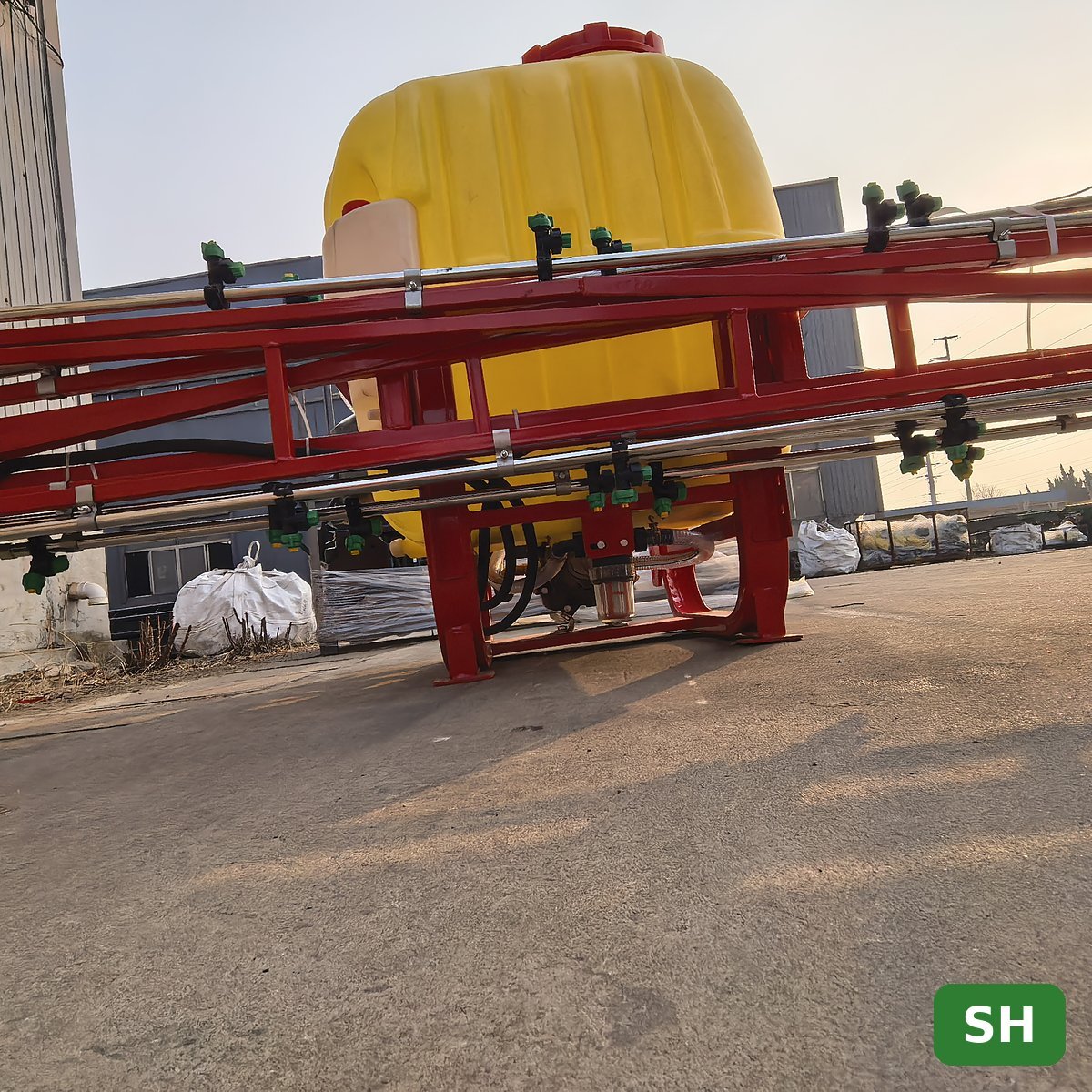
Tractor Boom Sprayer Sizes: SH P3SH Models
Our P3SH series is three-point mounted, with 6–10 m spray width and a rated pressure of 8 bar. Here are the tractor boom sprayer sizes we build:
| Model | Tank capacity (L) | Spray width (m) | Nozzles | Rated pressure (bar) | Tractor power (hp) |
|---|---|---|---|---|---|
| P3SH-200 | 200 | 6 | 12 | 8 | 20–30 |
| P3SH-300 | 300 | 6 | 12 | 8 | 30–35 |
| P3SH-400 | 400 | 6 | 12 | 8 | 40–45 |
| P3SH-500 | 500 | 10 | 20 | 8 | 50–55 |
| P3SH-700 | 700 | 10 | 20 | 8 | 70–75 |
| P3SH-800 | 800 | 10 | 20 | 8 | 75–80 |
| P3SH-1000 | 1000 | 10 | 20 | 8 | 100 |
For orchards and vineyards, the FS3SH air-blast series uses a large fan and 300–2000 L tanks. See our boom sprayer vs orchard air-blast sprayer guide if you grow trees as well as field crops.

How to Match Tank Size to Tractor HP and Farm Size
Tractor power: a full tank is heavy, so the tractor must lift it safely. Follow the matching power in the table; for example, a 50–55 hp tractor suits the P3SH-500.
Farm size: as a guide, 200–400 L suits small farms and 600–1000 L suits medium farms. Most farms with 10–30 hectares choose 400–800 L. Divide the area you want to spray in a day by the number of refills you can make to find your tank size.
Terrain: on hilly ground, choose a smaller tank for stability.
Crop: a 3 point boom sprayer is made for wheat, corn, soybean, rice, cotton and other flat field crops. Trees and vines need air assistance. The selection assistant shows every model that fits your tractor.
Boom Sprayer Calibration and Field Setup
Accurate application saves chemicals and protects the crop. Do a simple boom sprayer calibration before each season:
- Fill the tank with clean water, run the pump and check every nozzle for an even pattern.
- Collect the output of each nozzle for one minute. Replace any nozzle more than about ten percent above or below the average.
- Measure your forward speed over a known distance.
- Calculate litres per hectare and adjust pressure or speed to hit the label rate.
Keep the boom steady, usually about 50 cm above the crop for flat-fan nozzles, and spray in calm conditions in the early morning or evening to reduce drift.

Maintenance, Safety and Spare Parts
- Rinse the tank, pump and lines after every job, and never empty rinse water near wells or streams.
- Clean filters and nozzle tips with a soft brush, never with wire.
- Grease the PTO shaft and check hoses and clamps for leaks.
- Drain the pump and lines before freezing weather.
- Wear gloves, a mask and protective clothing when mixing and spraying.
Nozzles, filters and pump parts can be ordered with your machines, so dealers can keep the parts customers need most.

Common Buying Mistakes
- Buying the biggest tank without checking that the tractor can lift it.
- Using a boom unit for fruit trees, where spray cannot reach the canopy.
- Skipping calibration and over- or under-dosing the crop.
- Ordering without spare nozzles and filters.
- Choosing a wide boom for small, irregular fields where it cannot open fully.
Why Buy Direct from the Factory
Shenghang builds sprayers in our own factory in China and sells factory direct, with SH labelling, OEM options and export packing. We can ship sprayers together with seeders, row cultivators and 4WD tractors by sea, rail or air; see export and shipping. The FAO’s work on sustainable agricultural mechanization stresses well-maintained application equipment.
Not sure which tank size? Send us your tractor horsepower, crop and hectares, and we will recommend a P3SH model and the right nozzle set. Message us on WhatsApp +86 133 8469 2372 or .
Related guide: Orchard sprayer guide: choosing an air blast sprayer for fruit trees
Related guide: Boom Sprayer Calibration in 5 Steps: Litres per Hectare Made Simple
Boom Sprayer for Tractor FAQ
What size boom sprayer do I need for 20 hectares?
Most farms with 10–30 hectares choose a 400–800 L tank, depending on how many refills you can make per day.
Can a 3 point boom sprayer spray fruit trees?
Not well. Trees need air assistance to reach the canopy, so choose an air-blast model.
How often should I do boom sprayer calibration?
At least before each season, and whenever you change nozzles, pressure or forward speed.
How wide is a folding boom sprayer?
Our P3SH models spray 6 m (200–400 L tanks) or 10 m (500–1000 L tanks) and fold for transport.
Get a Quote
Send us the model (for example P3SH-500), quantity, tractor horsepower and destination port on WhatsApp +86 133 8469 2372. Or browse all SH sprayers and add the models you need to your inquiry.
Comments
Please log in to join the discussion. Log in Register