
Walking Tractor Buying Guide: Choosing a Two-Wheel Tractor and Implements
For smallholders, orchards, vegetable growers and paddy farmers, a walking tractor is often the first step into mechanization. One two-wheel machine can plough, till, plant, spray, mow, harvest and haul – simply by changing the implement. This walking tractor buying guide explains the main parts, how to choose horsepower and chassis, which implements to order, and how to keep the machine running for years.
What Is a Walking Tractor?
A walking tractor – also called a two-wheel tractor, hand tractor or power tiller – is a single-axle machine driven by a small diesel engine and steered by handlebars. The operator walks behind it, or sits on a seat fitted to the trailer or tiller. Because it is light and narrow, it works where a four-wheel tractor cannot: in terraces, small plots, greenhouses, orchards and wet rice fields.
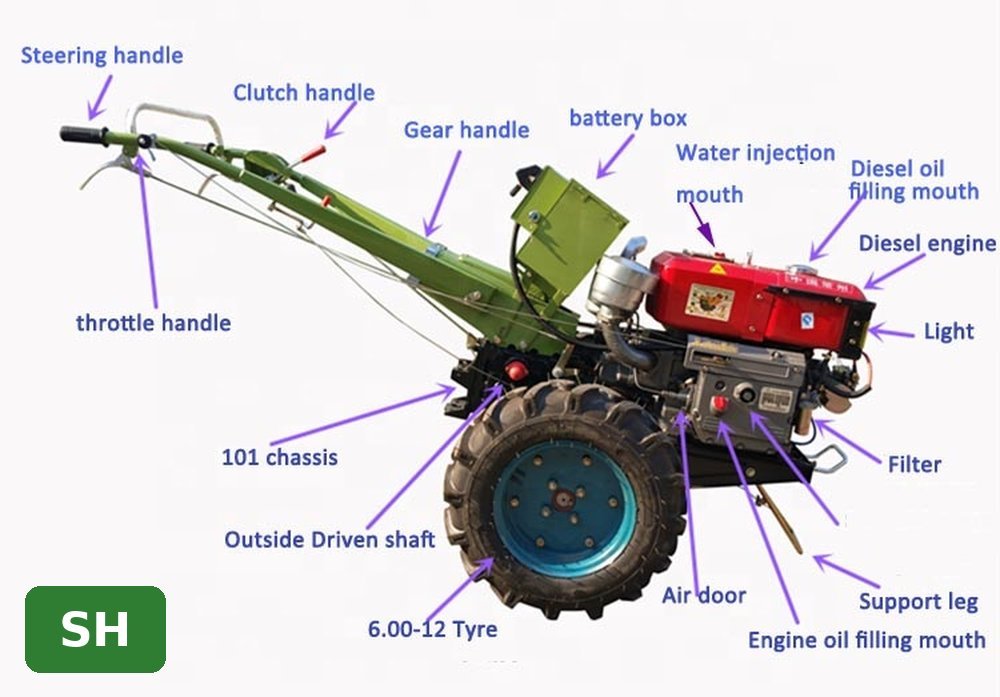
Main Parts of a Two Wheel Tractor
- Diesel engine: a single-cylinder engine, water-cooled or condenser-cooled, with hand-crank or electric start.
- Chassis and gearbox: our machines use the 101, 121 or 151 chassis, from light to heavy duty.
- Handles and controls: steering handles, clutch handle, gear handle and throttle.
- Wheels: pneumatic tyres such as 6.00-12 for dry land, or steel cage wheels for paddy fields.
- Hitch and PTO: to attach and drive rotary tillers and other implements.
How to Choose Horsepower and Chassis
Our walking tractors range from 8 to 25 HP:
- 8–13 HP on the 101 chassis: light and easy to handle, for gardens, greenhouses and vegetable beds under about 1 hectare.
- 15–18 HP on the 121 or 151 chassis: the most popular size for family farms of 1–3 hectares, with enough power for a rotary tiller or a small plough.
- 20–25 HP on the 151 chassis: heavy-duty models for hard soil, paddy work, larger plots and transport.
Choose electric start if the machine will be started many times a day; choose hand-crank start where batteries are hard to maintain. Water-cooled engines suit long working days; condenser-cooled engines need less water in dry regions.

Walking Tractor Implements
The real value of a hand tractor is the range of tools it can drive. We supply a full set:
- Tillage: rotary tillers (seat available), disc ploughs, single and double share ploughs, a trench digger for 25 × 25 cm trenches, ridgers and straw returning machines.
- Paddy work: convex-disc paddy wheels for wet fields.
- Planting and spraying: single and double-row corn planters, 4, 5 and 6-row wheat planters, a potato planter and a 100 cm film-covering sprayer.
- Harvest and transport: a two-disc mower, a rice and wheat reaper, and a trailer with a 2 m × 1 m × 0.3 m box.
Most buyers start with a rotary tiller, a plough and a trailer, then add planters and a reaper as the farm grows.

Walking Tractor or Four-Wheel Tractor?
A two-wheel machine costs far less, uses little fuel and turns in a small space, but it is tiring for the operator on large areas and has limited pulling power. Once a farm grows beyond a few hectares, or needs heavy implements such as wide disc harrows, a compact four-wheel tractor becomes more efficient. Compare our 4WD tractors from 20 to 200 HP, and see full-size rotary tillers and trailers for them.
Daily Care and Maintenance
- Check engine oil and coolant (or condenser water) every morning.
- Clean the air filter often in dusty conditions.
- Check gearbox oil and drive-belt tension weekly.
- Keep tyre pressure correct, and clean mud off cage wheels after paddy work.
- Drain water from the fuel filter and use clean diesel.
Shipping and Packing
Each machine can be packed in a large wooden crate together with its implements, which protects it in transit and makes good use of container space. We ship by sea, air and rail to dealers, cooperatives and farmers worldwide – see export & shipping.
Two-wheel tractors are often the most practical first machine for small farms. The FAO’s work on sustainable agricultural mechanization explains how the right equipment helps farmers save labour and work on time.
Related guide: Walking tractor attachments: 15 implements and which chassis they fit
Related guide: Choosing between water-cooled and condenser-cooled engines? Read our diesel walking tractor guide to cooling, starting and chassis.
Related guide: How to choose a walking tractor plough for your chassis and soil.
Walking Tractor FAQ
What can a walking tractor do?
With the right implement it can till, plough, ridge, plant corn, wheat and potatoes, spray, mow, harvest rice and wheat, and pull a trailer.
What is the difference between the 101, 121 and 151 chassis?
The 101 is for light 8–13 HP machines, the 121 for 15–18 HP, and the 151 is the heavy chassis for 15–25 HP that can be supplied with a rotary tiller.
How do I get a quotation?
See all models on our walking tractors page, then send the horsepower, implements, quantity and destination port by WhatsApp or email.
Is a power tiller the same as a walking tractor?
Mostly yes. In India and Southeast Asia a walking tractor fitted with a rotary tiller is usually called a power tiller. Our 8–25 HP power tiller models use the 101, 121 or 151 chassis.
Which walking tractor implements should I buy first?
Most buyers start with a rotary tiller, a plough and a trailer, then add planters, a reaper and a sprayer. Walking tractor implements can be packed in the same wooden crate as the machine. Send your list on WhatsApp for a quotation.
댓글
토론에 참여하려면 로그인해 주세요. 로그인 회원가입