
Manure Spreader vs Fertilizer Spreader: Which One Does Your Farm Need?
Manure spreader or fertilizer spreader – which one does your farm actually need? Both put nutrients back into the soil, but they handle very different materials, and buying the wrong type means clogged discs, uneven fields or a machine that sits unused. This guide compares the two, lists our four spreader series with real specifications, and shows how to match them to your tractor and the material you spread.
Need a recommendation? Tell us your tractor power, soil and crop on WhatsApp +86 133 8469 2372 or and we will reply with a matching model.
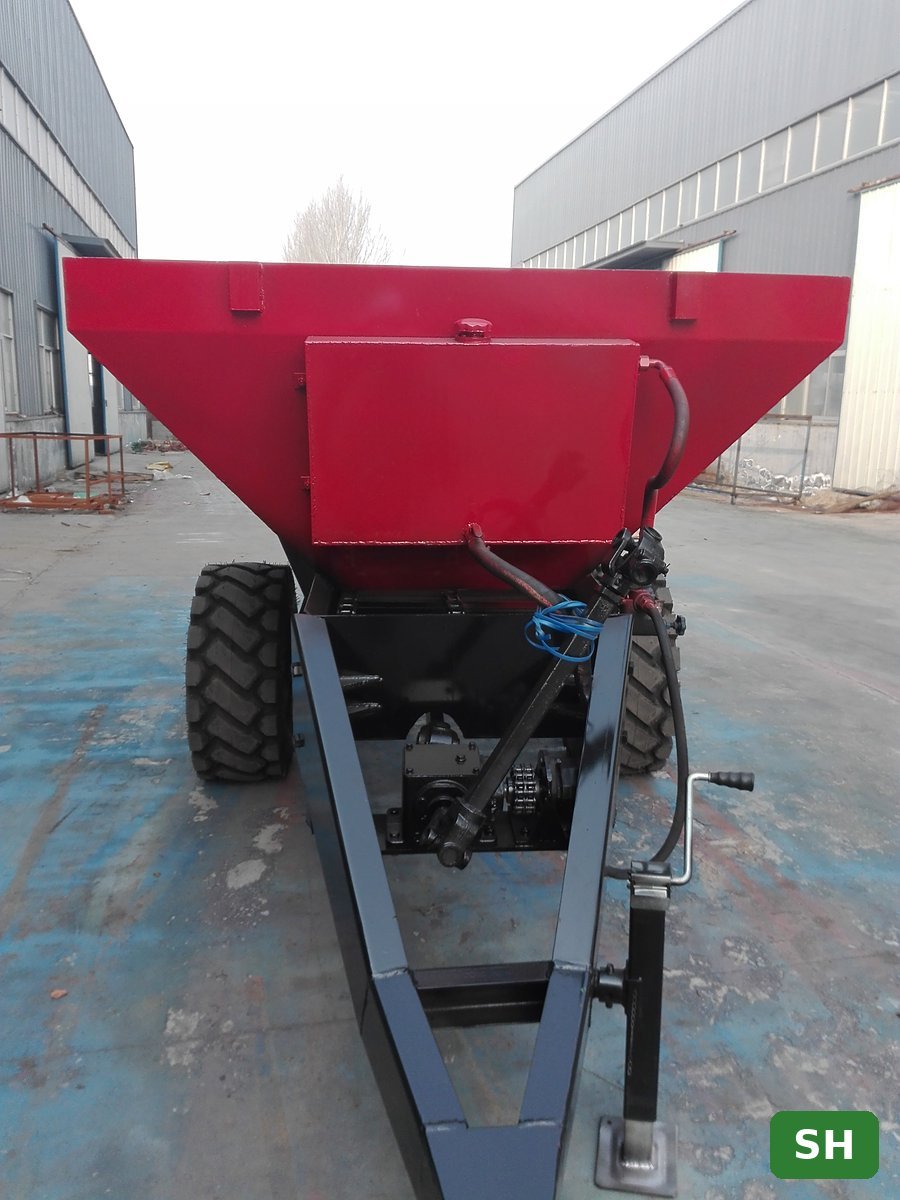
Manure Spreader vs Fertilizer Spreader: The Key Difference
The deciding question is what you spread.
- Dry, free-flowing material – granular mineral fertilizer, lime, pelleted organic fertilizer, even grass or wheat seed – goes in a spinner-disc spreader. Material drops from a hopper onto one or two spinning discs driven by the tractor PTO, which throw it in a wide fan. This is often called a broadcast spreader.
- Bulky, moist material – farmyard manure, poultry litter and compost – needs a wagon. A floor conveyor moves the load to rear beaters that shred and throw it behind the machine. This is what most farmers mean by a spreader wagon.
Put wet manure in a disc hopper and it bridges and blocks. Put granular fertilizer in a wagon and you cannot apply a light, even rate. Many livestock and mixed farms own one of each type.
Our Four Spreader Series Compared
Specifications below are from our manure spreaders page; customisation is available.
| Series | Type / hitch | Capacity (L) | Spreading width / radius | Tractor power (hp) | Best for |
|---|---|---|---|---|---|
| SSH (SSH-400 to SSH-1000) | Single disc, three-point mounted | 400–1000 | – | – | Fertilizer, seed, granular material; stainless steel hopper available |
| DSH (DSH-800 to DSH-1500) | Double disc, three-point mounted | 800–1500 | – | – | Wide, even spreading on large fields |
| CSH (CSH-260, CSH-600) | Round hopper, rear three-point mounted | 200–300 | 8–10 m radius | 12–50 | Small tractors; 10–15 ha/h at 5–8 km/h |
| WSH (WSH-2500 to WSH-12000) | Trailed wagon, 540 r/min PTO | 1400–7500 | 6–15 m width | 50 to 100+ | Farmyard manure, compost, organic fertilizer |
Within the WSH range, the WSH-2500 (1400 L, 970 kg) suits 50–60 hp tractors, the WSH-5500 (2300 L) 70–80 hp, the WSH-7500 (3750 L) 90–100 hp, and the WSH-12000 (7500 L, 2300 kg) tractors of 100 hp and above.
How to Choose the Right Spreader
Material. Granular fertilizer, lime or seed: choose a spinner unit. Wet manure and compost: choose a wagon.
Tractor power. CSH round-hopper units match 12–50 hp tractors. Wagons need 50–100+ hp depending on box size. Check that your tractor has a 540 r/min PTO with 6 splines for the WSH series. Our tractor horsepower guide helps with sizing.
Area and rate. Bigger hoppers and boxes mean fewer trips to refill. For large fields, a double-disc fertilizer spreader gives a wider, more even pattern than a single disc.
Corrosion. Fertilizer attacks mild steel. If you spread fertilizer every season, a stainless steel hopper on the SSH series lasts much longer.
Not sure? The selection assistant shows every model that fits your tractor.

Calibration and Field Tips for Even Spreading
- Check discs and vanes before each season. Bent or worn vanes change the throw and leave stripes in the crop.
- Use the rate chart, then test. Spread over a measured distance, weigh what was used, and adjust the hopper opening.
- Keep speed and engine rpm constant so the PTO stays at its rated speed.
- Overlap correctly. Set the distance between passes to the effective spreading width so the edges receive the full rate.
- Wagons: the floor conveyor speed sets the rate. A slower conveyor or faster driving gives a lighter application of manure or compost.
For moving bulk material around the farm, see our farm trailers and the farm trailer buying guide. For liquid fertilizer and crop protection, see our sprayers.
Maintenance and Spare Parts
Empty and wash the hopper or box after every use, because both fertilizer and manure corrode steel. Grease the PTO shaft, gearbox input and beater bearings regularly, and check gearbox oil. Inspect discs, vanes, conveyor chains and beater tines for wear. Store the machine dry and under cover between seasons. Keeping spare vanes and wear parts on hand avoids delays when the application window is short.

Common Buying Mistakes
- Buying one machine for every material. A disc spreader will not handle wet manure; a wagon will not apply fertilizer evenly.
- Oversizing the wagon. A full 7500 L box is heavy; make sure the tractor can pull and brake it safely on your terrain.
- Skipping calibration. Uneven spreading wastes fertilizer and lowers yield.
- Choosing mild steel for heavy fertilizer use when a stainless steel hopper is available.
Why Buy Direct from the Factory
All SSH, DSH, CSH and WSH spreaders are built in our own factory in China and sold factory direct. Dealers can choose SH labelling or OEM options, and every order gets export packing with shipping by sea, rail or air – see export and shipping. Returning manure and compost to fields is part of the FAO’s approach to sustainable agricultural mechanization and soil health.
Spreading manure, fertilizer or both? Tell us the material, your farm size and tractor horsepower on WhatsApp +86 133 8469 2372 or and we will match a series and size.
Related guide: Manure Spreader Wagon Guide: 4 Sizes from 1400 to 7500 L
FAQ
Can a fertilizer spreader handle wet manure?
No. Disc spreaders need dry, free-flowing material such as granular or pelleted fertilizer. For farmyard manure and compost, use a wagon-type machine.
What size manure spreader wagon fits a 60 hp tractor?
The WSH-2500 with a 1400 L box is listed for 50–60 hp tractors.
Is a compost spreader different from a manure spreader?
In practice they are the same machine: a box with a floor conveyor and rear beaters. Our WSH wagons handle both materials.
Which tractor fertilizer spreader suits a small tractor?
The CSH round-hopper series is made for 12–50 hp tractors, with an 8–10 m working radius and 10–15 ha/h output.
Get a Quote
Send us the model (for example WSH-5500 or DSH-1000), quantity, your tractor horsepower, the material you spread and destination port on WhatsApp +86 133 8469 2372. See all models on our spreaders page.
Comments
Please log in to join the discussion. Log in Register