
Farm Trailer Buying Guide: 7 Key Checks Before You Buy
A farm trailer is often the machine that works the most days of the year. It carries grain to the store, feed to the animals, fertilizer to the field and produce to the market. Yet many buyers choose a farm trailer only by price or by load, and later find that it is too heavy for their tractor, too slow to unload, or rusting after two seasons. This guide gives dealers and farmers seven practical checks for choosing the right farm trailer, from 0.5 t walking tractor trailers up to 12 t four-wheel models.
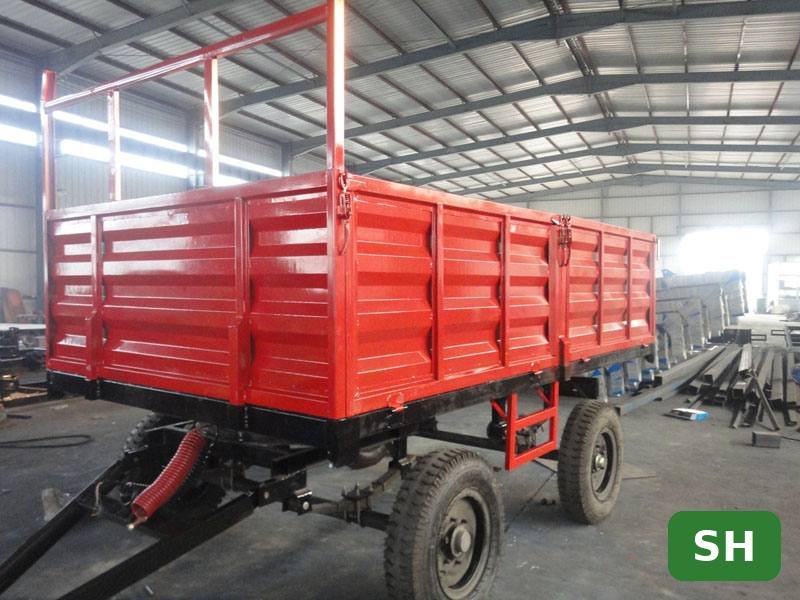
1. Match the Farm Trailer to Your Tractor Power
Tractor power is the first filter. A trailer that is too big for the tractor is hard to stop on slopes and wears the clutch and brakes quickly. Our tractor trailers are grouped by matching power:
- Walking tractors, 12–20 hp: 7SH-0.5, 7SH-1 and 7SH-1.5 with 500, 1000 and 1500 kg rated loads.
- Small four-wheel tractors, 12–25 hp: two-wheel trailers T7SH-1.5 / HT7SH-1.5 (1500 kg) and T7SH-2 / HT7SH-2 (2000 kg).
- 30–60 hp tractors: four-wheel F7SH-3 to F7SH-5 and their hydraulic HF7SH versions, 3000–5000 kg.
- 50–100 hp tractors: F7SH-6 to F7SH-12 and HF7SH versions, 6000–12000 kg.
If you are still choosing the power unit, see our 4WD tractors and walking tractors first, then size the trailer to suit.
2. Two Wheels or Four Wheels?
A two-wheel trailer puts part of the load on the tractor drawbar. It is short, turns tightly and is easy to reverse into yards and narrow lanes, so it suits small farms and loads up to about 2 t. A four-wheel trailer carries the whole load on its own axles. It is more stable at speed and on long road trips, and it is the normal choice from 3 t upward. For 10 t and 12 t loads, our F7SH-10 and F7SH-12 run on eight tyres to spread the weight.
3. Manual Tipping or Hydraulic Dump Trailer
How you unload decides how much labour each trip needs.
- Manual unloading is simple, light and low-maintenance. It suits bagged goods, boxes and bales that are unloaded by hand anyway.
- Hydraulic dump trailer versions (HT7SH and HF7SH models) tip the body backward using the tractor hydraulics. They save time with loose loads such as grain, sand, manure, cassava or sugar cane.
Before ordering a hydraulic dump trailer, check that the tractor has a working remote hydraulic outlet.

4. Check Brakes and Tyres
Braking is a safety point, not an extra. Walking tractor trailers use a foot brake; 1.5–2 t two-wheel models offer impact or air brakes; the 3–12 t four-wheel models come with manual brakes on the manual version and air brakes on the hydraulic version. For hilly roads or heavy loads, air brakes give more control. Tyre size grows with load, from 4.00-12 on the 7SH-0.5 to 9.00-20 on the 7–12 t models. Ask your dealer whether local tyre sizes are easy to replace.
5. Carriage Size and What You Carry
Rated load is only half the story; volume matters too. Light, bulky crops such as hay, straw and green fodder fill a carriage long before they reach its weight limit. Compare the carriage dimensions, for example 3400 × 1700 × 460 mm on the 3 t models and 6500 × 2200 × 550 mm on the 12 t models. If you move bales from a baler, a longer, wider body is usually more useful than extra rated load.
6. When to Choose a Galvanized Trailer
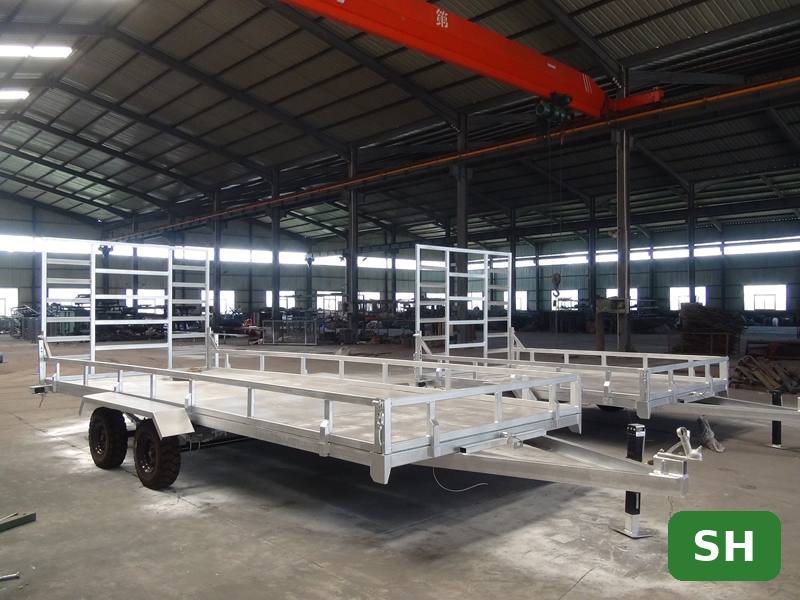
Hot-dip galvanized trailers resist rust in humid, coastal and high-rainfall areas. Our galvanized range includes single-axle G1SH models (650–1400 kg), tandem-axle G2SH models (2000–3000 kg) and GH2SH hydraulic tandem tipping models (2000–3000 kg) with a tool-box remote control and battery. They have chequer-plate floors, folding sides with a 600 mm slot-in cage and LED lights, and suit livestock farms, gardens and light transport.
7. Plan the Whole Farm Trailer Fleet
Many farms run two trailers: a large four-wheel farm trailer for harvest and a small one for daily jobs. Dealers can stock a mix of sizes to cover walking tractor users and larger tractor owners. Combining trailers with other machines in one container also lowers freight per unit; see our export and shipping page. Reliable transport is a basic part of sustainable agricultural mechanization, because it cuts post-harvest losses and saves labour.
Related guide: Hydraulic dump trailer guide: sizes from 1.5 to 12 tons
Related guide: 2 wheel vs 4 wheel trailer: 5 differences in load, safety and price
Related guide: Walking tractor trailer guide: tipping trailers for 12–20 HP two-wheel tractors
Farm Trailer FAQ
What size farm trailer suits a 50 hp tractor?
The F7SH-4 / HF7SH-4 (4 t, 40–55 hp) and F7SH-5 / HF7SH-5 (5 t, 40–60 hp) fit this power. The F7SH-6 (6 t) is listed for 50–90 hp, so it is better for flat ground.
Do you make trailers for walking tractors?
Yes. The 7SH-0.5, 7SH-1 and 7SH-1.5 carry 500–1500 kg and match 12–20 hp walking tractors, with manual back tipping and a foot brake.
Is a hydraulic dump trailer worth the extra cost?
If you often carry loose loads, yes. Tipping saves labour on every trip. For bagged goods or bales, a manual model is often enough.
When should I choose a 4 wheel trailer?
Choose a 4 wheel trailer from about 3 t upward or for long road trips, because it carries the whole load on its own axles and is more stable at speed. Our F7SH range runs from 3 to 12 t for 30–100 hp tractors, with hydraulic HF7SH versions.
Is a galvanized trailer worth it?
In humid, coastal and high-rainfall areas, yes. A hot-dip galvanized trailer resists rust for longer. Our galvanized range runs from 650 kg single-axle to 3000 kg tandem-axle hydraulic tipping models.
What details do you need for a quotation?
Tell us your tractor horsepower, the typical load (weight and type, such as grain, bales or sand), whether you need tipping, the brake type you prefer, your road conditions, the quantity and the destination port. With these details our team can confirm the right model, suggest spare parts and quote freight by sea or rail. Dealers can mix several sizes in one container to lower the cost per unit. Contact us on WhatsApp.
How do I keep a trailer in good condition?
Grease the hitch, axle bearings and tipping pivots regularly, check tyre pressure and wheel nuts before each trip, inspect brake linings and air lines, and keep hydraulic hoses free of leaks. Never load the body beyond its rated load, and wash off fertilizer and manure after use to prevent corrosion.
Get a Quote
Tell us your tractor power, typical load and destination port, and we will recommend a farm trailer model. Browse the full farm trailer range, or use the selection assistant to match machines to your tractor.
Comments
Please log in to join the discussion. Log in Register